

6 Criteria to Build a Mobile App for Business
The Question That Always Comes Too Late
"Why isn't anyone using the app?"
That question usually gets asked after the app launches and the budget is spent—not before. And the numbers back that up exactly:
88% of users abandon an app after hitting bugs or a poor user experience (QualiTest, a survey of 1,000+ users). And according to Miquido (2026), 95% of in-house attempts to build AI-powered apps without specialized oversight risk failure.
This failure isn't in the coding—it's in the decisions made before it.
This article won't teach you how to code an app—coding—it lays out the strategic questions you need to answer before writing a single line of code.
Context First — Why an App Is a Strategic Decision, Not a Technical One
The mobile app market reached $330.61 billion in 2025, and native apps deliver conversion rates 3x higher than mobile websites, with a 157% increase in overall conversion rates (Cmarix, 2026).
These numbers make an app a clear business opportunity. But they also explain why so many companies pay for an app that doesn't deliver—the market's sheer pull pushes people toward a quick decision at the expense of deliberate planning.
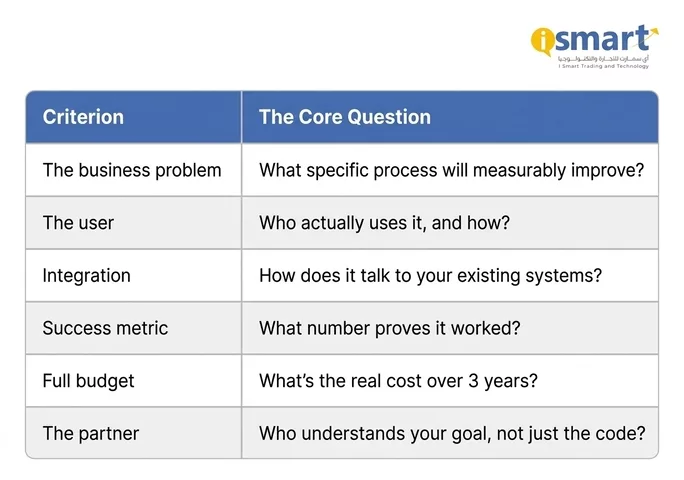
An app that delivers business results starts with clear answers to six questions—before any meeting with a development company.
Criterion 1: What Business Problem Does the App Solve—Precisely?
This question is harder than it sounds. The common answer, "We want an app for our customers," isn't a problem statement—it's a solution statement.
A real business problem looks like this:
- "Our customers call to track their orders—and that eats up 3 hours a day of our customer service team's time."
- "Our field staff fill out paper forms that get manually entered into the system later—a constant source of errors and delays."
- "Our customers book service through WhatsApp—no organized record, no automatic confirmation, no schedule management."
Each of these problems calls for a different type of app, with different functions, a different audience, and a different definition of success.
The question you need to answer: which specific business process will measurably improve after the app launches?
Criterion 2: Who Is the User—and What's Their Actual Digital Behavior?
An app designed "for everyone" fits no one. Precisely defining your user determines everything else—the interface, the language, the functions, the target screen size, and even which platform to build for first.
Questions that need answers:
- Is the user an internal employee or an external customer? (B2B app or B2C?)
- Which device dominates your audience—iOS or Android? Android accounts for more than 71% of app downloads worldwide, but iOS generates more than 61% of revenue—and that gap matters a great deal when setting development priorities.
- What's the user's technical skill level? Are they already using similar apps?
- In what context is the app used—at a desk, in the field, or on the move?
The common mistake: designing the app around what the management team wants—not what the actual user needs.

““A successful mobile app is built before the first line of code—with a clear business problem, the right users, and a strategy designed for measurable results.”
— iSmart”
Criterion 3: How Does the App Integrate With Your Existing Systems?
An app disconnected from your company's systems creates a new digital island—an extra data source that needs manual management. That erases most of the value you were hoping to get from it.
Before development starts, your integration map needs to answer:
- Does the app need to communicate with an existing ERP, CRM, or accounting system?
- How does data flow between the app and other systems—one direction, or both?
- Is data synced instantly or periodically?
- What APIs are available in your current systems?
95% of IT leaders point to integration issues as a major obstacle in digital transformation initiatives. An app whose integration is planned from the start avoids that obstacle—one that addresses it later pays for it twice over.
Criterion 4: What Does Success Look Like—and How Do You Measure It?
"We want a successful app" isn't a criterion—success has to be a specific, measurable number tied to a specific timeframe.
Sample success indicators by app type:
For an internal app (employees):
- Reducing time to complete a specific task by X%
- Lowering the data-entry error rate from X to Y
- Raising procedure compliance from X to Y%
For an external app (customers):
- Order conversion rate through the app compared to other channels
- User retention rate after 30 days
- Reducing transaction completion time from X to Y minutes
Research suggests that features that don't cut "task completion time" by at least 30% need a full architectural re-evaluation. That single criterion alone rules out a lot of attractive features that don't actually add value.
Criterion 5: What's the Full Lifecycle Budget—Not Just Development?
The most common mistake in app budgets: accounting for development cost only and neglecting the rest of the lifecycle.
Full budget components to include:
Initial development: building the first version—costs vary widely depending on complexity and the team chosen.
Testing and quality assurance: an IBM model shows that fixing a bug after launch can cost up to 30 times more than catching it during the design phase—making early testing investment one of the highest-ROI decisions you'll make.
Launch and marketing: an app with no users produces no value.
Ongoing maintenance and updates: the operating system changes, and user expectations evolve—an app is a living entity that needs continuous care.
Cloud infrastructure: hosting, server, and security costs.
Iterative development: the first version isn't the finish line—it's the starting point.
The practical rule: annual maintenance and iterative development budget typically equals 15–20% of the initial development cost.
Criterion 6: Who Is the Right Partner—and What Should You Look For?
67% of in-house app development projects fail without specialized oversight (Miquido, 2026). Choosing the technical partner is the decision that determines the fate of every criterion before it.
Criteria for choosing a development partner:
Sector experience: has the partner built apps in your sector or a similar one? Sector experience cuts development time and reduces errors caused by not understanding industry requirements.
Development methodology: do they work in Agile, with staged, reviewable deliverables? Or do they disappear for months and hand over a finished product at the end? Iterative delivery allows for early correction, before change becomes expensive.
Documentation and ownership: who owns the code? Is full documentation handed over? Can you move to another partner later without losing everything that was built?
Post-launch support: launch isn't the finish line—it's the start of the most important phase. A partner who disappears after delivery ends up costing you more than they saved you on the competitive quote.
Documented references: ask to speak directly with past clients on similar projects—don't settle for a portfolio page on their website.
Before the Six Criteria—A Deeper Question: Is an App Even the Right Solution?
Sometimes the business problem you identify in Criterion 1 is better solved by something simpler, faster, and cheaper than a full mobile app—a web app, an integration with an existing platform, or improving a process instead of automating it.
A technical partner who raises this question with you—instead of rushing straight to an app-development pitch—is a partner putting your interests ahead of closing the deal.
That's exactly where iSmart starts every development project: analyzing the actual need before proposing the solution—because the right app in the wrong context produces a bad experience, not a business result.
Conclusion — A Successful App Is Built Before the First Line of Code
These six criteria aren't an administrative checklist—they're a thinking framework that separates an app used daily from one downloaded once and forgotten.
Talk to the iSmart team to evaluate your project before you start—the right assessment saves far more than the development itself costs.
Read Also:
Digital Transformation for Mid-Sized Companies — A Roadmap With Clear Stages
{{ replyingTo ? replyingToText + ' ' + replyingTo.name : leaveCommentText }}
Search News
Popular category
Follow Us

Media Center
Subscribe for industry insights
All rights for iSmart company
{{page.totalItems}} Comments