

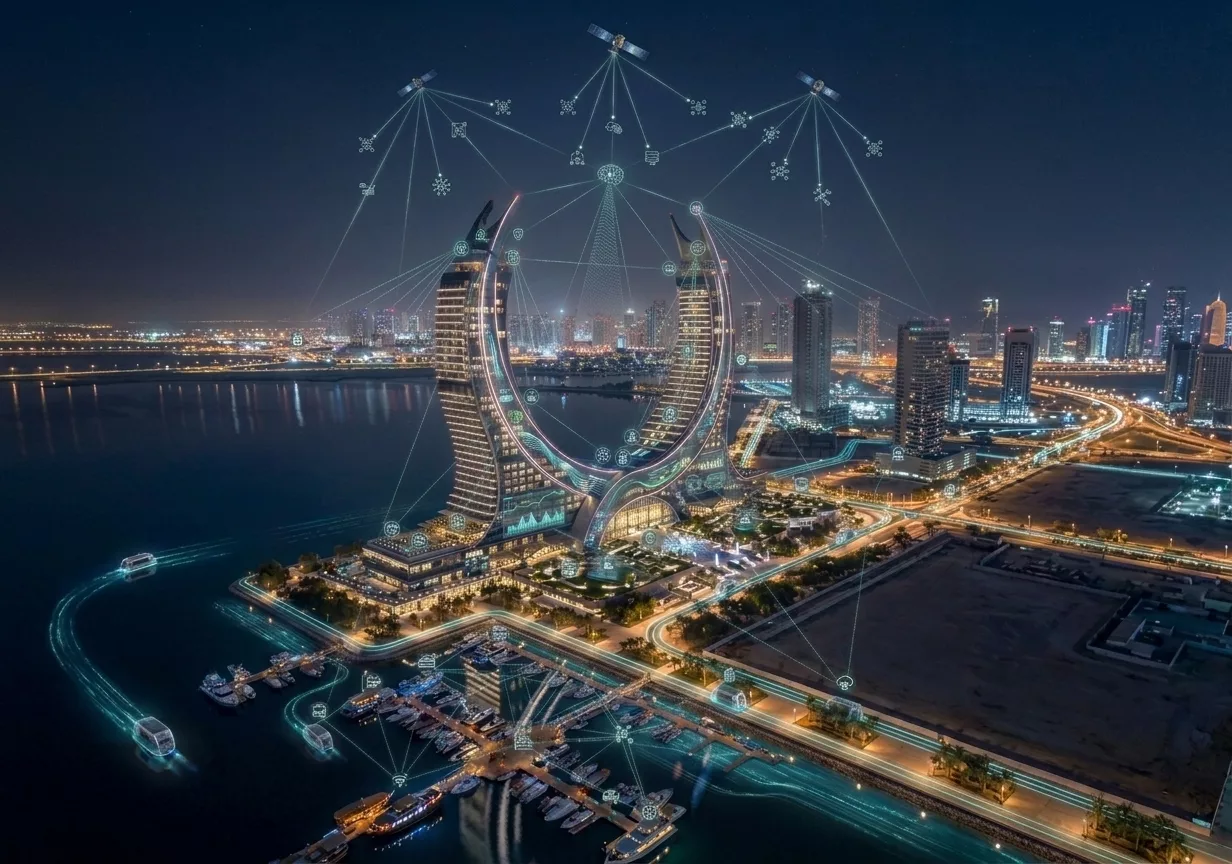
How do digital integration solutions enable smart cities in Qatar?
A City That Thinks—But Does It Talk to Itself?
Doha, November 2025: ranked 33rd globally and 3rd regionally on the IMD Smart City Index. Msheireb Downtown Doha: 430 kilometers of fiber-optic cable and more than 650,000 IoT devices monitoring buildings, homes, and communities. Lusail: a $60 million partnership with ST Engineering to build an AI platform unifying lighting, buildings, and traffic into a single system.
The numbers are impressive. But they raise a fundamental question:
When a city has this many smart systems—hospitals, roads, buildings, power grids, government services—how do those systems talk to each other? And what happens when they don't?
That's the question digital integration solutions answer—and it's what separates a city that owns smart technology from a city that's actually smart.
1. Qatar and Smart Cities — Where Things Stand Today
National Investment
Qatar's investment in priority digital technologies — including AI, IoT, and cybersecurity — jumped from $1.65 billion in 2022 to a projected $5.7 billion by the end of 2026, according to the "Smarter Qatar" report from Invest Qatar and the Ministry of Communications and Information Technology (MCIT) .
Qatar's smart cities market reached $3.31 billion in 2025, and is projected to hit $10.9 billion by 2034, growing at 14.14% annually (IMARC Group).
Existing Initiatives
TASMU Smart Qatar: the most comprehensive national initiative, run by the Ministry of Communications and Information Technology (MCIT), with a budget of QR 6 billion and a roadmap of 114 digital use cases across 5 priority sectors: transport, logistics, environment, health, and sports.
A new TASMU phase, launched in November 2025, includes developing more than 30 national smart solutions and building a National Digital Twin hosted in sovereign data centers, for use in policymaking and urban planning.
Lusail and Msheireb — two real-world models of smart cities, both using AI to manage traffic, energy, and public safety in real time.
The Hukoomi platform, whose updated version launched in June 2026 as the first output of the "Digital Transformation Factory," brings technology, data, and design together into one unified government platform.
2. The Core Challenge — What Actually Holds Smart Cities Back?
Smart cities aren't, first and foremost, a technology challenge—they're an integration challenge. The systems exist, the technology is available, and the investment is substantial. The deeper dilemma is: how do you get these systems to talk to each other?
A study published in Taylor & Francis (2024) defines this problem precisely: smart-city digital systems often operate as "vertical silos"—unable to communicate with one another due to a lack of shared standards and unified interfaces.

““A smart city is not defined by how much technology it has, but by how effectively its systems connect, communicate, and create value.”
— iSmart”
The Four Core Challenges
1. Interoperability: IoT devices from different vendors, government systems built at different times, separate sector-specific applications—each speaking a different "language." A study in Springer Nature Link demonstrates that this challenge blocks value extraction from aggregated data and prevents the development of integrated citizen services.
2. Data silos: when data doesn't flow between sectors, its value stays confined within its own boundaries. Transport data never reaches the energy system, and health data never feeds urban-planning decisions. A ScienceDirect study (September 2025) confirms that this isolation limits comprehensive analysis and weakens decision quality.
3. Cybersecurity and privacy: expanding IoT networks also expands the risk exposure. Protecting citizen data while enabling it to flow between systems is a delicate balance that requires an integrated security architecture from day one—not a patch applied later.
4. Scalability and sustainability: cities grow. Smart systems have to grow with them. An architecture that works for 50,000 IoT devices can collapse under a million devices without scalable design built in from the start.
3. What Does Real Digital Integration Actually Mean?
Digital integration in a smart-city context isn't about connecting cables or installing middleware—it's about building a system that enables:
Connecting sectors in a unified environment: when a traffic incident flows as real-time information that reroutes ambulances, lights up diversion signals, and sends alerts to mobile devices—all within seconds, without human intervention at every step.
Real-time analytics across the system: data gathered from multiple sources—sensors, surveillance cameras, energy systems, and transport networks—converted into unified dashboards that let officials make decisions based on the complete picture, not a fragmented one.
Workflow automation between systems: procedures that once required manual coordination across multiple entities—infrastructure maintenance, energy management, traffic control—are automated based on real data and pre-programmed scenarios.
Scalability as the city grows: architecture built on open standards and unified APIs that let new systems be added without rebuilding what's already there.
4. The Sectors Most Affected by Digital Integration in the Qatari Context
Qatar has clear sector priorities that determine where digital integration has the most impact:
Transport and Urban Mobility
An AI-powered system in Lusail analyzes traffic data in real time to improve flow and cut carbon emissions—but its full impact is only realized once it's linked to public transport, emergency, and infrastructure systems on a single platform.
Energy Management and Sustainability
The Qatari government spent roughly QR 1.5 billion ($412 million) on AI projects in Lusail, including energy-consumption optimization—integration between sensors and central control systems maximizes that impact.
Health and Community Care
Linking health records to emergency systems and healthcare facility management cuts response times and improves resource allocation—a challenge that requires integrating historically disconnected systems.
Digital Government Services
The new Hukoomi platform is a clear example: unifying more than 400 government services into one integrated portal instead of scattered platforms.
The Digital Twin
The National Digital Twin project announced in November 2025 requires deep integration across diverse urban data sources—the most technically complex challenge in Qatar's smart-city ecosystem.
iSmart's expertise in smart city solutions supports exactly this kind of transformation through developing and integrating AI- and IoT-based solutions and connecting data, infrastructure, and services within unified digital systems. iSmart's experience spans urban analytics, facility management, smart transport, and real-time dashboards—aligned with the requirements of connected cities and digital twins.
Book a free demo to see our projects.
5. What Separates Successful Integration From Failed Integration?
A 2025 Sensors study from the University of Alicante offers a data-driven framework for assessing digital integration readiness in smart cities, identifying three core requirements:
First—data infrastructure before the technical solution: integration starts with a clear definition of data sources, standards, and quality—before choosing any platform or technology.
Second—open standards, not closed solutions: systems built on open standards and documented APIs enable future expansion and integration. Closed solutions create technical lock-in that costs more later.
Third—governance and roles before implementation: who owns the data? Who has the right to access it? How are conflicts of interest between entities resolved? These are governance questions that come before technical ones.
6. iSmart's Role in the Digital Integration Ecosystem
In the Qatari and wider Gulf context, digital integration doesn't just mean connecting major urban systems—it also means seamlessly connecting institutions, companies, and government entities to the smart-city ecosystem.
iSmart Trading & Technology provides digital integration solutions that enable organizations to:
- Connect their internal systems to smart-city platforms and TASMU initiatives, following open standards
- Build integration interfaces (APIs) that let data flow between existing systems without rebuilding them
- Automate workflows across multiple systems to reduce manual intervention and improve response speed
- Ensure scalability as integration requirements grow alongside the city's expansion and evolving initiatives
This role—connecting an organization to the smart-city ecosystem—is what turns government infrastructure investment into real value at the level of every organization, company, and government entity.
Conclusion—A Smart City Isn't a Project. It's an ongoing process
Qatar is moving with real momentum toward an ambitious digital future. The numbers and initiatives prove it. But the deeper lesson from smart-city experiences worldwide is a single one: technology alone doesn't make a city smart—integration between technologies is what does.
The organization that understands this dynamic and builds its digital presence to integrate with the city's ecosystem rather than operate apart from it will be the one in the strongest competitive position in the Qatari market over the coming years.
Read Also:
5 AI Trends Shaping the Future of Business
Related Tags
Social Share
{{ replyingTo ? replyingToText + ' ' + replyingTo.name : leaveCommentText }}
Search News
Popular category
Follow Us
Tags

Media Center
Subscribe for industry insights
All rights for iSmart company
{{page.totalItems}} Comments