


How Do You Choose the Right ERP System for Your Company?
An Investment Decision That Shapes Your Company's Trajectory for Years
The right ERP system can save millions over its lifetime. The wrong one can turn into a costly project that's hard to walk back from. That's why choosing an ERP system isn't a technical decision — it's a strategic, investment-level decision that shapes your company's growth for years.
The numbers make the weight of this decision clear: according to Gartner, between 55% and 75% of ERP projects fail to meet their stated objectives. Panorama Consulting's 2025 report adds that the overall failure rate sits at 68%, while implementation costs exceed the planned budget by an average of 189% across industries.
The number-one cause of these failures — in 42% of cases — isn't the system itself. It's how it was chosen and implemented.
This guide lays out seven objective criteria for making an informed decision — one that starts with a clear diagnosis of your requirements, not with being dazzled by a sales pitch.
What Is an ERP System? — The Starting Point
Before getting into selection criteria, it helps to understand what you're actually choosing. See our article: What Is ERP? for a full explanation.
In short: ERP is a platform that brings together the data and operations of your company's departments — finance, inventory, HR, sales, projects — into a single, integrated system. The right decision changes how your company is run. The wrong one just adds a new layer of complexity on top of the complexity already there.
The Seven Criteria
Criterion 1: Start With Diagnosing Your Problems, Not Comparing Feature Lists
The most common mistake: starting from feature lists before diagnosing the actual problem.
Before any sales pitch or comparison, ask your team:
- Where does our data conflict today?
- Which tasks are still done manually that could be automated?
- Which reports take hours when they should take minutes?
- Where are we losing time coordinating between departments?
The answers to these questions are your real requirements map — and they determine which system actually fits.
Practical step: Document core processes across at least five departments before contacting any vendor.

““The right ERP is more than software—it’s a strategic foundation that connects your business today and prepares it for tomorrow.”
— iSmart”
Criterion 2: Total Cost, Not the Sticker Price
The price quoted in a sales pitch is the smallest line item in the real cost equation.
According to Panorama Consulting, the leading causes of budget overruns are: underestimating staffing costs (38%), scope expansion (35%), and data and technical integration issues (34%).
Total Cost of Ownership (TCO) components to include:
- Licensing fees (monthly/annual, per user)
- Implementation and setup
- Customization and configuration
- Data migration from legacy systems
- Training and onboarding
- Technical support and annual maintenance
- Future upgrade costs
Practical step: Ask every vendor for a 3-year TCO comparison — not just an initial quote.
Criterion 3: Sector Fit
An ERP system that succeeded in retail doesn't mean it will perform just as well in construction, healthcare, or manufacturing.
Sector-specialized systems come with modules and reports that reflect that industry's specific needs — reducing the need for customization and speeding up rollout.
Questions to ask the vendor:
- How many clients do you have in my sector?
- Do you have references specifically in the Gulf market?
- What specialized modules do you offer for my industry?
Criterion 4: Scalability and Room to Grow
The company choosing a system today isn't the same company it will be in five years.
What to assess:
- Does the system support adding new modules later?
- How does growth in user count affect performance and cost?
- Can new branches and legal entities be added without changing systems?
Criterion 5: Ease of Use and Adoption Speed
A system your team doesn't use effectively is a failed system — regardless of its technical specs. According to Gartner, poor user adoption is the number-one factor in ERP failure after go-live.
Practical step: Request a trial version and hand it to a non-technical member of your team — their reaction is a more accurate signal than any sales presentation.
Criterion 6: Fit With the Local Regulatory Environment
In the Gulf market, this criterion is non-negotiable. The system needs to support:
- VAT in line with each Gulf country's requirements
- Locally required financial reporting formats
- Local payroll and leave-management requirements
- Hosting options that comply with local data-protection requirements
Criterion 7: Quality of the Local Partner — The Variable That Matters Most
Research consistently shows that the implementation partner is the strongest predictor of ERP project success — even more than the quality of the system itself.
What to evaluate in a partner:
- Documented experience in your sector and company size
- Local presence and the ability to provide on-the-ground support
- A clear implementation methodology with measurable stages
- References from real clients you can contact directly
- A clear, documented post-delivery support model
Warning Signs When Choosing an ERP Vendor
Before signing with any vendor, these signals warrant a pause and closer scrutiny:
Focusing on price alone — a vendor who leads with price before understanding your needs isn't consulting, they're closing a deal.
No clear implementation plan — a project with no defined stages, milestones, or measurable timelines is a project with no accountability.
Refusing to provide client references — a vendor confident in their work welcomes contact with past clients.
Heavy customization from the start — excessive customization in the first phase signals a system that doesn't actually fit your sector.
No local support team — remote support doesn't replace on-the-ground experience that understands the Gulf market.
No trial version offered — a system you can't test before buying is hiding weaknesses you won't discover until it's too late.
Is the System AI-Ready?
In 2026, this question has become a core part of any ERP evaluation — not an optional add-on.
Ask the vendor these specific questions:
Does it support AI Agents? — can the system execute chains of decisions and actions independently?
Does it include predictive analytics? — does it anticipate problems before they happen, rather than just reporting them after?
Does it support a Copilot or a built-in smart assistant? — can any user interact with their data in plain language?
Can workflows be automated with AI? — does automation go beyond fixed rules into decisions that adapt to context?
A system that can't answer "yes" to most of these questions today will need additional investment to keep pace tomorrow.
Conclusion — The Framework That Guides the Decision
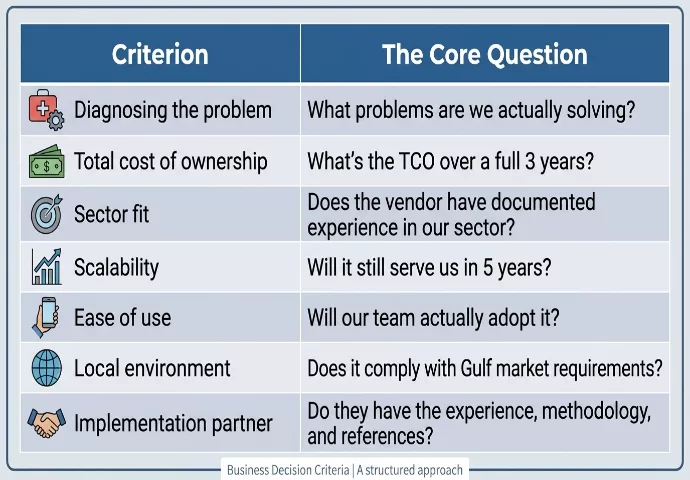
Explore the two ERP options iSmart offers:
Odoo ERP — Global Flexibility, Local Expertise
SmartPro ERP — AI-Powered ERP System
Or talk to the iSmart team for a tailored assessment that starts with understanding your business.
Related Tags
Social Share
{{ replyingTo ? replyingToText + ' ' + replyingTo.name : leaveCommentText }}

Media Center
Subscribe for industry insights
All rights for iSmart company
{{page.totalItems}} Comments