

Why Choose Odoo ERP?
And How to Roll It Out Successfully in the Gulf Business Environment?
The Question Most Managers Put Off — Until It's Too Late
Choosing an ERP system is a decision you live with for years. The mistake doesn't show up tomorrow — it shows up six months into the rollout, when the system is technically running but not actually delivering, or when real costs have blown far past what was budgeted.
That's why the right decision isn't built on marketing claims — it's built on objective, measurable criteria.
This article walks through ten analytical criteria for choosing an ERP system, and places Odoo in that context against traditional systems — objectively, without overselling.
1. Understanding the Context Before Comparing
The global ERP market reached $147.7 billion in 2025 — a number that reflects just how much competition and choice exists. That range of options is exactly what makes the decision complex.
Major systems like SAP, Oracle, and Microsoft Dynamics dominate the large-enterprise segment — but they're built primarily for companies with substantial budgets and dedicated in-house IT teams. Mid-sized companies, which make up the largest segment of the Gulf market, need a different equation.
Odoo emerged out of that gap — and addresses it directly.
2. Ten Criteria for an Informed ERP Decision
Criterion 1: Pricing Model and Total Cost of Ownership
Cost isn't just the subscription fee — it includes implementation, customization, training, ongoing support, and upgrades. This is what's known as Total Cost of Ownership (TCO).
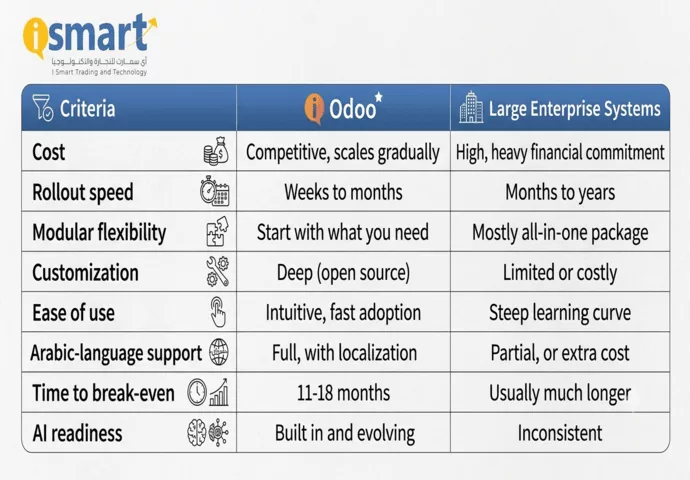
Major traditional systems start at $99–$150 per user/month for core modules, with implementation, customization, and support fees on top that push total TCO very high for most mid-sized companies.
Odoo Enterprise starts at $24.90 per user/month, with the option to start on the free Community edition to evaluate the system before committing to an upgrade.
The question to ask: What's the total cost over 3 years, covering every element — not just the subscription fee?
Criterion 2: Modular Flexibility and Scalability
An ERP system that locks you into the full package from day one is a system that weighs down your budget before it's proven any value.
A modular model lets you start with your priority modules — accounting and sales, for example — then add HR, projects, and inventory gradually as the company grows.
Odoo runs on exactly that logic: start with what you need today, and scale at your pace — not the system's.
Criterion 3: Rollout Speed and Time to Productivity
A long ERP rollout means disrupted operations, added pressure on your team, and a delayed return.
For standard business models (sales, inventory, accounting), the average Odoo rollout runs between two weeks and six months, depending on project complexity — compared to months or years for major traditional systems.
92% of companies that implemented Odoo rated the transition "smooth" or "very smooth," and 89% reported less than 48 hours of downtime during the switch.
Criterion 4: Customization — Depth and Ease
Every company's processes differ, to some degree, from everyone else's. A system that can't be customized forces you to adapt your processes to it — and that means losing competitive advantages.
Because Odoo is open source, it can be modified at the code level, not just configured. But the key caution here: over-customizing complicates future upgrades. The gold standard — customize where it's necessary, and stick to standard configuration everywhere else.

“"The right ERP isn't the one with the most features, it's the one that aligns with your business, scales with your growth, and delivers measurable value from day one." iSmart”
Criterion 5: Ease of Use and Adoption Speed
A system that takes months to train your team on is a system that slows down your return on investment.
Odoo consistently ranks among the easiest systems to use and the fastest for user adoption — which reduces team resistance to change and accelerates the path to full productivity.
A 2025 Panorama Consulting survey found that 88% of mid-sized companies that implemented ERP reported improved decision quality, and 68% recorded a rise in customer satisfaction.
Criterion 6: Integration with External Systems
No company operates in a digital vacuum. An ERP system needs to integrate with e-commerce platforms, point-of-sale systems, shipping systems, payment gateways, and analytics tools.
Odoo's ecosystem includes more than 16,000 apps, with open API integration capabilities that connect to most external systems without costly middleware.
Criterion 7: Arabic-Language Support and Local Requirements
In the Gulf market, this criterion isn't negotiable. A system without native Arabic support adds friction for your team and reduces data accuracy.
Odoo offers localization for more than 40 countries, with full support for local tax and regulatory requirements — including across the Gulf — through localization packages developed by local partners.
Criterion 8: Hosting Model and Data Control
Odoo offers three options: Odoo Online (fully managed SaaS cloud), Odoo.sh (cloud with code-level customization), and On-Premise (hosted on the company's own servers). This range is rare among competing systems and lets companies choose the model that best fits their security and operational needs.
Criterion 9: Community and Ongoing Support
An open-source system means a global community continuously contributing to its development. Odoo has one of the most active ERP communities — more than 20,000 modules across the community ecosystem, with regular updates adding new capabilities with every release.
The flip side: community-based support can sometimes mean slower resolution for less common issues. That's exactly why a specialized local partner becomes a requirement, not an option.
Criterion 10: AI Readiness
Odoo is increasingly weaving AI into its core functions — from demand forecasting to suggested delivery dates and supplier recommendations. That means investing in Odoo today is investing in a platform that gets smarter with every new release.
3. Quick Comparison Table
4. When Odoo Isn't the Best Fit
Objectivity means acknowledging cases where alternatives are worth considering:
Organizations with exceptionally complex finances that need highly advanced multi-entity consolidation reporting.
Advanced, specialized manufacturing that requires very complex MRP functionality — though Odoo has improved noticeably here in recent releases.
Companies deeply built around Microsoft 365 that need deep integration across the full Microsoft environment.
In these cases, SmartPro ERP or other solutions may be a better fit — and the right evaluation always starts with understanding your company's specific needs.
5. The Partner Comes Before the System
Implementation research consistently points to one fact: the specialized partner is the strongest predictor of a successful rollout.
A good system with an inexperienced partner produces a mediocre rollout. A good system with a specialized partner produces a real transformation.
At iSmart, we follow a clear methodology: we analyze your processes first, then determine whether Odoo is the right fit — and only then implement it, if it is.
Want to Find Out If Odoo Is Right for Your Company?
for a free, tailored assessment.
Read Also:
Odoo ERP in Qatar — The Global Platform, Implemented Locally
{{ replyingTo ? replyingToText + ' ' + replyingTo.name : leaveCommentText }}
Search News
Popular category
Follow Us

Media Center
Subscribe for industry insights
All rights for iSmart company
{{page.totalItems}} Comments