


Odoo ERP: Features, Benefits, and Local Implementation
16 Million People Use ERP Platform — What Makes It the Right Fit for Your Company in Qatar?
Odoo ERP: What It Is, What It Can Do, and What Changes When It's Implemented by Local Experts
A Platform That Outgrows the Label "ERP System"
Call something an "ERP system" and a certain image comes to mind: heavy software, steep costs, a rollout that drags on for months, and an in-house IT team just to keep it running. Odoo breaks that image.
Not because it's simpler than it looks, but because it's more flexible than the market has come to expect from ERP. It's an open-source platform bringing together more than 1,000 business apps in one integrated environment – currently serving over 16 million users and 170,000 companies across more than 100 countries and adding more than 13,000 new customers every month.
This article looks at what Odoo actually is, what sets it apart structurally from traditional systems, why it's gaining ground in the Gulf market, and why the local partner implementing it can make or break the result.
1. What Is Odoo, Really? — Beyond the Standard Definition
For a broader look at what an ERP system actually is, see our article: What Is ERP?
Odoo isn't a classic, closed-box ERP. It's a modular, open-source system that lets companies start with exactly the modules they need, then scale up gradually — without ever switching platforms.
The formula behind it looks simple, but the impact runs deep: real integration + customization flexibility + competitive cost = a management system that grows with your company.
The numbers back it up:
- 5.77% global market share in the ERP sector, and 12–15% in the mid-market segment.
- €650 million in revenue in 2025, with 42% year-over-year ARR growth.
- A valuation above €7 billion, placing it among the top 5 privately held software companies in its category worldwide.
- Average time to break even: just 11–18 months.

“"Technology alone doesn't transform businesses. The right implementation does. At iSmart, we don't just deploy Odoo—we build an ERP ecosystem that grows with your business."
— iSmart Trading & Technology”
2. The Modular Architecture — How Odoo Actually Works
Unlike large systems that force you to buy the entire package, Odoo runs on a "pay for what you use" logic:
Core Business Modules
▪️ Accounting & Financial Management: A full financial cycle from invoicing to bank reconciliation, with real-time reporting and multi-currency support. Accounting entries generate automatically with every transaction, eliminating manual double-entry.
▪️ Sales & CRM: From quote to payment collection — with a full history per customer, sales performance analytics, and dashboards tracking every deal in the pipeline.
▪️ Inventory & Warehousing: Real-time tracking of product movement, receiving and shipping tracking, and automatic alerts when stock runs low.
▪️ Human Resources: From hiring to payroll — employee records, attendance, payroll runs, leave, and performance reviews.
▪️ Procurement & Supply Chain: End-to-end purchasing management with supplier tracking, linked directly to inventory and accounting.
▪️ Project Management: Planning, task assignment, and progress tracking — tied directly to each project's financials.
Additional Specialized Modules
Point of Sale (POS), e-commerce, manufacturing (MRP), marketing automation, asset management, and over 1,000 modules across the full ecosystem.
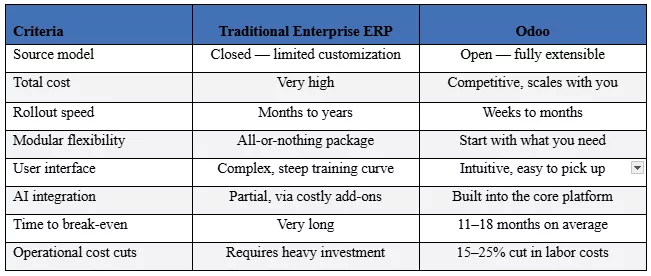
3. What Structurally Sets Odoo Apart? — An Objective Comparison
4. Odoo and the Gulf Market — A Growing Context
The MENA region is seeing accelerated adoption of flexible ERP systems, driven by clear structural factors:
▪️ Institutional digital transformation: National transformation agendas across the region require government and semi-government entities to modernize their administrative systems, driving growing demand for ERP solutions.
▪️ Mid-market growth: The segment Odoo primarily targets (10–500 employees) is the fastest-growing segment in Qatar and the wider Gulf market.
▪️ Tax and regulatory requirements: VAT requirements and local financial reporting standards have pushed many companies to move from manual tools to integrated ERP systems.
▪️ Rising technical maturity: Growing technical capability inside Gulf companies is making it easier to adopt more complex, integrated systems.
The global open-source ERP market is valued at $2.85 billion in 2025 and is projected to reach $4.60 billion by 2030, growing at 10.05% annually — with emerging markets accounting for a steadily rising share of that growth
5. The Real Challenges of an Odoo Rollout
Strong numbers don't mean a rollout is risk-free. There are documented challenges worth understanding before you commit:
▪️ Over-customization complexity: Odoo's flexibility is a double-edged sword — customizing without a clear methodology complicates maintenance and drags out the rollout. Customization needs to be deliberate, not open-ended.
▪️ The partner determines the outcome: A non-specialized Odoo partner can deliver a system that works technically but doesn't actually serve the company's real operations. Choosing a partner based on sector and local expertise — not price alone — isn't optional.
▪️ Managing the human side of change: The technology gets delivered — real transformation happens when the team actually adopts it well. The absence of a clear training and change-management plan is the number one reason ERP rollouts fail worldwide.
▪️ Data migration: Moving data from legacy systems (spreadsheets, standalone accounting tools) requires careful cleanup and verification. Incomplete or conflicting data undermines system accuracy from day one.
6. What iSmart Adds in the Gulf Market Context
Odoo is a global platform. But rolling it out in the Qatari market takes more than general technical expertise — it takes a deep understanding of the local business environment.
Here's what iSmart Trading & Technology brings as an implementation partner in Qatar:
▪️ Built-in tax and regulatory compliance: Local financial reporting and VAT requirements are handled from day one — not addressed later through costly customization.
▪️ True bilingual design: Arabic and English are both native to the platform — not a partially translated interface.
▪️ A proven implementation methodology: Current process analysis → customization that reflects how your company actually works → phased rollout → hands-on training → ongoing support. Every stage is documented and measurable.
▪️ A partnership that outlasts delivery: Go-live isn't the end of the project. Continued development as your company grows is part of the model.
Conclusion — Odoo Isn't a Software Decision. It's a Strategic One.
16 million users didn't choose Odoo just because it's cheaper or simpler — they chose it because it lets their companies build a management system that grows with them, not one that boxes them in.
But the system alone isn't enough. The partner guiding your rollout is what separates a system that works from a system that delivers.
Ready to See If Odoo Is the Right Fit for Your Company?
Talk to the iSmart Team for a needs assessment tailored to you. Weighing multiple ERP options? See SmartPro ERP to understand the difference between the two.
Read Also:
{{ replyingTo ? replyingToText + ' ' + replyingTo.name : leaveCommentText }}
Search News
Popular category
Follow Us

Media Center
Subscribe for industry insights
All rights for iSmart company
{{page.totalItems}} Comments