

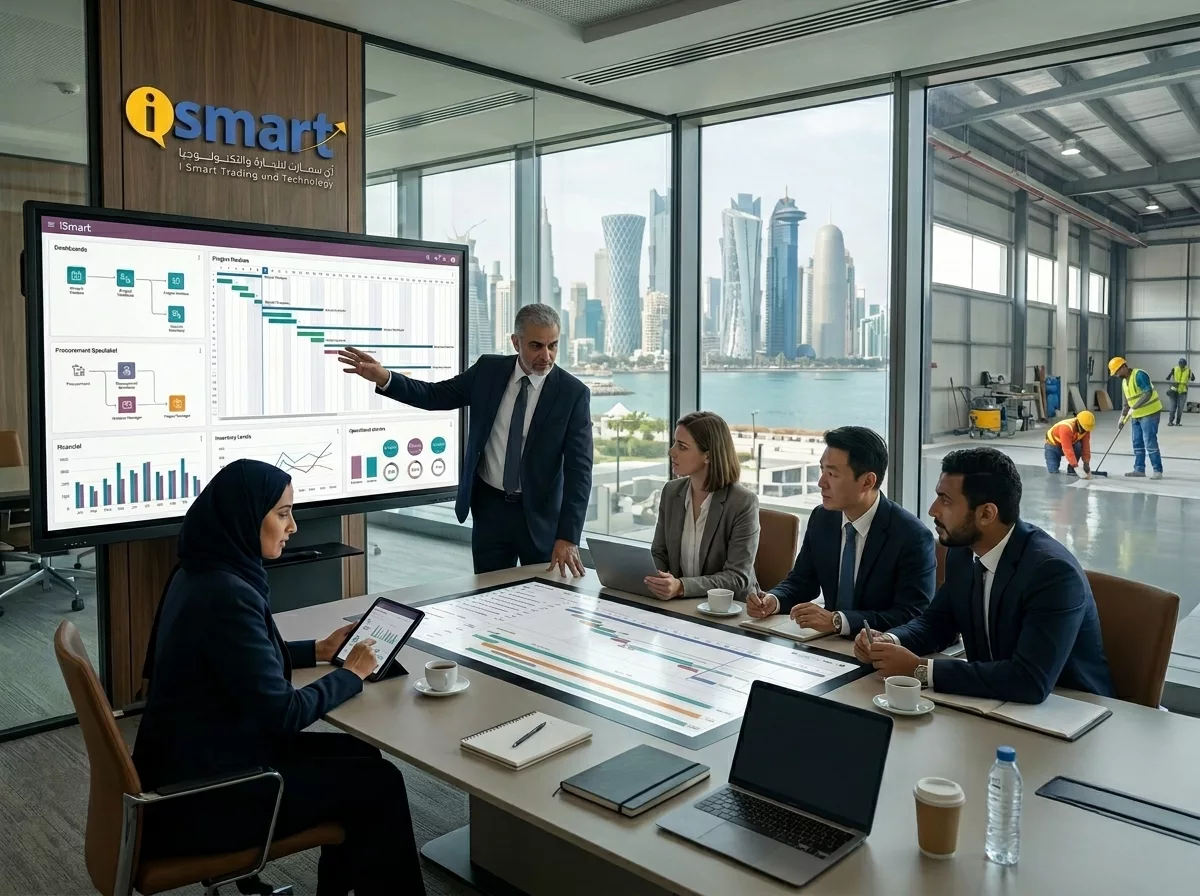
How iSmart Helped NKraft Achieve Sustainable Operations with Odoo ERP
When an ERP System Becomes a Partner in Environmental Sustainability
How iSmart Unified NKraft Al Jabor's Operations Through Odoo ERP
The Problem Every Fast-Growing Service Company Runs Into
When a service company grows fast, that growth itself becomes a source of pressure.
Projects multiply. Suppliers diversify. Field teams expand. And leadership ends up facing a real dilemma: how do you keep accuracy and coordination across all these parallel operations — without burning your time chasing scattered data?
That was exactly the dilemma facing NKraft Al Jabor for Services — the leading provider of sustainable, eco-friendly flooring solutions in the Qatari market.
1. Who Is NKraft Al Jabor?
NKraft Al Jabor specializes in high-quality environmental flooring solutions — from epoxy and polymer flooring to solutions built for hospitals, schools, industrial facilities, and offices. Its work sits at the intersection of two parallel complexities: technical complexity in its products and solutions and operational complexity in managing multiple projects and diverse suppliers simultaneously.
Companies like this face a specific challenge: their projects run a full lifecycle — from quote to delivery to collection — and each project carries its own budget, resources, and procurement. Managing that with disconnected tools leads to conflicting data and decisions based on incomplete information.
2. The Analysis — What Was Holding Efficiency Back?
Before iSmart stepped in, NKraft Al Jabor was facing a pattern common among fast-growing Gulf service companies:
▪️ Project costs impossible to track in real time. Every project needed manual data-gathering from scattered sources just to know its actual cost — a process that ate up time and carried a high margin for error.
▪️ An unstructured procurement workflow. Purchase requests moved through informal channels, making them hard to track, stretching out the purchasing cycle, and turning supplier comparison into guesswork instead of a measured process.
▪️ Accounting disconnected from operations. Linking financial transactions to specific projects required duplicate manual entry — once in the field system, once in accounting — opening the door to mismatches and gaps.
▪️ Sales and project execution stuck in separate silos. A contract signed by the sales team didn't flow automatically to the execution team. Every handoff required manual transfer and re-entry of data.
▪️ No unified view for leadership. Decision-makers had to compile reports from multiple sources just to see the full picture of company performance — meaning slower, less accurate decisions.

“The value of ERP isn't measured by the software you install—it's measured by the operational clarity, efficiency, and growth it enables. That's the transformation we deliver at iSmart."
— iSmart Trading & Technology”
3. The Solution — Odoo ERP Built Around Four Core Modules
After an in-depth analysis of NKraft Al Jabor's operations and the nature of its projects, the iSmart team designed a solution built on four interconnected Odoo modules:
Accounting
The goal wasn't just recording transactions — it was connecting them to operational context. Every invoice, payment, and bank reconciliation is now generated automatically and reflected instantly in financial reports, with no manual intervention. The result: a finance manager who sees cash flow and project performance in real time, not at month's end.
Purchase
A fully structured procurement cycle — from internal request, to manager approval, to comparing supplier quotes, to goods receipt, to invoice recording and automatic accounting entries. That means full traceability, controlled budgets, and stronger supplier relationships.
Sales
From quote to invoice — one continuous path with no breaks. Contract data flows automatically into an execution project with no re-entry, and any change in scope or pricing is reflected instantly in accounting and procurement.
Project Management
The real heart of the solution for NKraft. Every project has a timeline, tasks assigned across the team, a defined budget, and costs tracked in real time against plan. When a project runs over budget or behind schedule, the manager knows immediately — not after the fact.
4. What the Research Says About Transformations Like This
NKraft's experience isn't an outlier. Research on Odoo ERP implementations for service companies shows recurring patterns:
- Companies that connect project management and finance on a single platform substantially improve cost-tracking accuracy and reduce budget overruns.
- 92% of companies that implemented Odoo described the transition as "smooth" or "very smooth" when led by a specialized partner.
- ROI break-even on Odoo implementations for mid-sized companies typically falls between 12–18 months when built around clear, standard objectives.
- Automating the procurement cycle cuts processing time by up to 40% in multi-supplier service environments.
What makes NKraft's implementation interesting is that the company wasn't looking for an off-the-shelf technical fix — it was looking for a system that would free it up to focus on what it does best: sustainable flooring solutions and innovation in environmental project delivery
Success Factors — What Made This Rollout Actually Deliver
ERP implementation research consistently points to one pattern behind failed projects: focusing on the technology while neglecting the human and methodological side. On the NKraft project, the iSmart team took a different approach:
▪️ Analysis before configuration. The project began with an in-depth analysis of current operations, not by opening a laptop and installing the system. Understanding the full lifecycle of NKraft's projects was the prerequisite for any customization.
▪️ Deliberate customization, not excessive. Odoo is highly flexible — but too much flexibility complicates maintenance and upgrades. The team customized the system to reflect NKraft's actual operations while preserving as much of the standard functionality as possible, to facilitate future development.
▪️ Hands-on training at every level. From the project manager tracking budgets, to the procurement officer issuing purchase requests, to the accountant reviewing entries — every user received training built around their specific tasks.
▪️ Support through the stabilization period. The first 90 days after launch are the most critical stretch of any ERP rollout. The iSmart team stayed available to resolve issues that surfaced as the company adjusted to the new system.
6. The Broader Lesson — ERP in the Environmental Services Sector
Qatar's environmental services and specialized construction sector faces challenges that traditional trade doesn't: long-running projects, specialized materials with volatile pricing, and strict quality requirements tied to environmental standards.
An ERP system built with that specificity in mind delivers fundamentally different value than one installed "out of the box" with no adaptation.
That's exactly what NKraft Al Jabor's partnership with iSmart reflects — a partnership built on deep sector understanding before it was ever built on technology.
Running a Service or Project-Based Company in Qatar?
If you're facing similar challenges — multiple projects, costs that are hard to track, or operations eating up your team's time on manual coordination — the answer may not be hiring more people or expanding the team. It may be restructuring how your data and operations are managed.
Talk to the iSmart Team for a tailored analysis that starts with understanding your business — not with a product demo.
Read Also:
{{ replyingTo ? replyingToText + ' ' + replyingTo.name : leaveCommentText }}
Search News
Popular category
Follow Us

Media Center
Subscribe for industry insights
All rights for iSmart company
{{page.totalItems}} Comments