


What is ERP?
Enterprise Resource Planning (ERP) is one of the most important systems modern organizations rely on to run their daily operations efficiently. Whether you are managing a small business or a global enterprise, ERP solutions help bring structure, visibility, and control to complex business processes.
This article explains what ERP is, how ERP in business works, and why organizations across industries depend on ERP systems.
What Is an ERP System? The Short Answer
ERP stands for Enterprise Resource Planning. In practical terms, an ERP system is integrated management software that brings all of your company's departments — accounting, inventory, human resources, sales, and procurement — onto a single platform, running on one shared database in real time.
Instead of every department working in its own system and its own spreadsheets, an ERP system lets everyone see the full picture, at the same moment.
One example shows the idea. The sales team issues an invoice → inventory updates automatically → the accounting entry is recorded instantly → it appears in the financial report. Nobody types the data in twice.
That is ERP at its core.
What Does ERP Mean? Where the Term Comes From
The term ERP was first used in 1990 by Gartner to describe a new generation of manufacturing management systems that had grown to cover every function of the enterprise.
Before ERP, companies typically ran:
- A separate accounting system.
- A separate inventory system.
- Excel spreadsheets for HR.
- WhatsApp or email for internal coordination.
The result: conflicting data, late decisions, and hours lost every day pulling together information that should already have been ready.
ERP was created to solve exactly that problem.
How Does an ERP System Work?
An ERP system rests on three connected building blocks:
1. A central database. A single source of truth: all data is stored in one place that every department can reach in real time. No duplicate copies, no conflicting numbers.
2. Specialized, integrated modules. Each module serves one department (finance, inventory, HR, and so on) but is integrated with the rest. An event in the sales module automatically affects inventory and finance.
3. Automated workflows. Routine procedures run on their own according to predefined rules — purchase approvals, invoice issuing, inventory alerts — without someone stepping in at every stage.

“ERP is not just software; it is the brain that connects business operations and turns data into smart decisions.”
The Core Modules of an ERP System
ERP modules vary by system and by industry, but the standard set usually includes:
- Financial management – General ledger, budgets, financial reporting, cash flow.
- Human Resources (HR) – Payroll, recruitment, attendance, employee records.
- Inventory and supply chain - Stock movement, warehouses, supplier management.
- Procurement - Purchase requests, quotations, supplier contracts.
- Sales and CRM - Invoices, sales orders, customer relationship management.
- Project management - Planning, tasks, cost control.
- Manufacturing - Production planning, quality control.
Microsoft highlights that ERP systems are designed to scale, allowing businesses to add or remove modules as their needs grow.
Cloud ERP vs On-Premise ERP — Which Suits You?
This is one of the most common questions when a company is thinking about adopting an ERP system:
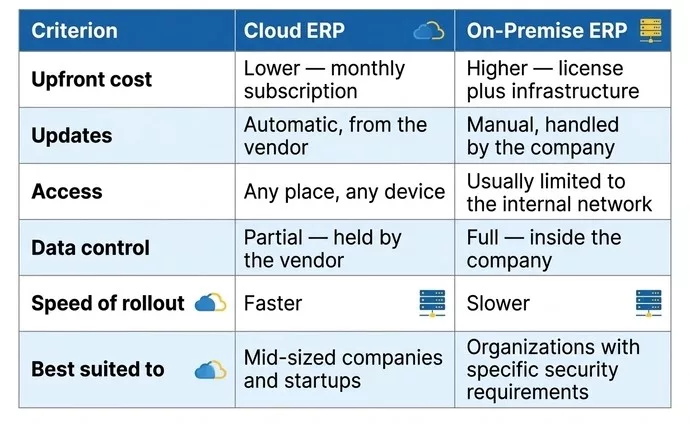
The global trend in 2026: the cloud ERP market passed $72 billion in 2025 and is heading toward $182 billion by 2030 (Grand View Research). Nine out of ten new ERP implementations at mid-sized companies choose the cloud model.
What Are the Real Benefits of an ERP System? Documented Numbers
Talk of "improved efficiency" has become routine. Documented numbers say more. These are largely survey-based and self-reported figures from industry sources:
- 66% of organizations report noticeable efficiency gains after implementing ERP (10xERP, 2026).
- 30% lower procurement and inventory management costs (10xERP).
- 30% better performance in rule-based processes once automated.
- 36% faster decision-making in small and mid-sized businesses after implementing ERP.
- 91% of organizations that implemented ERP report improvements in inventory levels.
These numbers come with a condition: they materialize when the system is implemented well, with upfront analysis, real training, and a technology partner who understands the sector.
Who Needs an ERP System? Five Signs That Tell the Story
There's no fixed size threshold. But these signs show clearly that the time has come:
1. Your data is spread across more than one system or spreadsheet. When you have to pull data from Excel, an accounting system, and WhatsApp messages just to know where your company stands, that's the gap an ERP system closes.
2. Reports take days, not minutes. If preparing a monthly report occupies an entire team, your systems aren't keeping up with your people.
3. Human error in data entry is costing you. Every piece of data entered by hand twice is another chance for a mistake. ERP removes the duplication.
4. Your departments don't "talk" to each other. Sales doesn't know the stock position. Procurement doesn't see demand forecasts. These isolated islands lead to poorer decisions.
5. Your company is growing and your operations aren't keeping pace. A company that has doubled in size but still runs on the same tools is living on borrowed time.
ERP in Qatar and the Gulf — What's Different?
The Gulf market adds requirements that need to be part of the picture:
- Native Arabic support — not a translation layered on after implementation.
- Alignment with VAT and the local tax requirements in each country.
- A payroll system that follows Qatari and Gulf labor regulations.
- The official report formats required by government bodies.
These aren't optional extras. They're operational requirements that should be built into the system from the start, rather than added later at a higher cost.
For the full picture of the ERP market in Qatar and the share held by leading systems: ERP Systems in Qatar — A 2026 Guide for Companies
What's the Difference Between Traditional ERP and AI-Powered ERP?
Today's generation of ERP systems does more than unify data. It turns data into decisions:
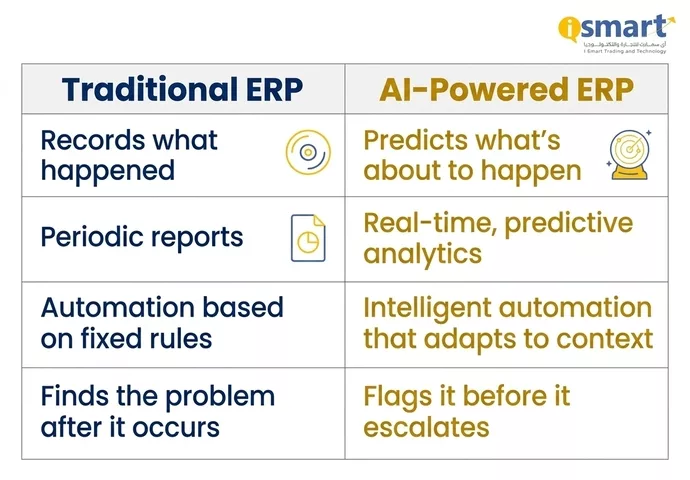
That is what SmartPro ERP delivers — an AI-powered ERP system designed for the Gulf market. More on how this kind of system works: When Your Company's Data Stops Recording the Past and Starts Shaping the Future
How Do You Choose the Right ERP System for Your Company?
Choosing well pays off. According to the Standish Group, 55–75% of ERP projects don't reach their goals, and weak selection criteria are a major reason.
Seven criteria point to the right decision:
- Diagnose your actual problems before comparing systems.
- Calculate total cost of ownership (TCO) over three years, not just the initial price.
- Check sector fit and local references.
- Assess scalability as the company grows.
- Test ease of use with the real user, not the manager.
- Confirm alignment with the local regulatory and tax environment.
- Evaluate the implementation partner — not only the system.
For the complete guide: How Do You Choose the Right ERP System for Your Company?
Frequently Asked Questions About ERP Systems
- What does ERP mean in Arabic?
ERP stands for (enterprise resource planning) — an integrated software system that unifies the management of all of a company's departments on one platform.
- What's the difference between ERP and accounting software?
Accounting software manages finance only. An ERP system manages finance, inventory, HR, sales, procurement, and more — all integrated in a single system.
- Do small companies need an ERP system?
Size doesn't determine the need — operational complexity does. A mid-sized company with intertwined operations may need ERP more than a large company with simple ones.
- How long does it take to implement an ERP system?
It ranges from a few weeks for standard modules to several months for complex projects. Cloud systems such as Odoo, for mid-sized companies, average between 4 and 16 weeks.
- What's the best ERP system for my company?
There's no absolute "best" — only the best fit for your company's size, sector, and budget. iSmart offers a free assessment that starts with understanding how your business works.
Conclusion — ERP Isn't Software. It's a Way of Thinking.
At its core, ERP isn't about technology. It's about unifying how your company works around a single, trusted body of data. Technology is the tool; the real value is the clarity it produces — in performance, in decisions, and in responsibilities.
The companies that succeed with ERP aren't the ones that picked the best-known system. They're the ones that understood their problems well before choosing the solution.
See what an ERP ecosystem looks like in the Qatari market:
Odoo ERP — Features, Benefits, and Local Implementation
5 Stages of Digital Transformation for Medium Businesses in Qatar
Or talk to the iSmart team for a free assessment that answers two questions: does your company need ERP now, and which system fits it specifically?
Related Tags
Social Share
{{ replyingTo ? replyingToText + ' ' + replyingTo.name : leaveCommentText }}
Search News
Popular category
Follow Us

Media Center
Subscribe for industry insights
All rights for iSmart company
{{page.totalItems}} Comments