iSmart
"The businesses that will lead Qatar's next growth phase are the ones digitizing today, not the ones waiting for certainty. SmartPro ERP gives them that head start."


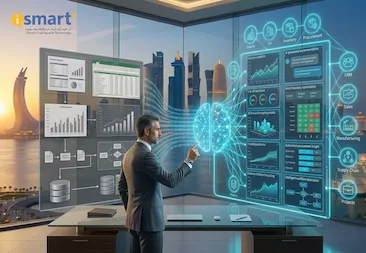
Every company has data. Few know how to make that data think. That's the real shift AI brings to ERP. The system is no longer just a warehouse for transactions and reports — it has become a platform that analyzes, predicts, and recommends, continuously and in real time.
This article looks at how that shift works technically, what value it actually delivers, and the challenges worth weighing before any rollout.
For the fundamentals of ERP, see our article on What Is ERP?
ERP systems were built to solve one clear problem: bringing a company's scattered data into a single place. They succeeded. But that success exposed a deeper one — companies ended up with huge volumes of data and no fast enough way to turn it into decisions that keep them competitive.
AI closes exactly that gap. Once it's built into ERP, accumulated data stops being a historical record and becomes a real-time decision engine.
This isn't one new feature bolted on — it's a redefinition of what the system does:
Algorithms that scan historical and live data for patterns invisible to the human eye. What sets them apart is that they keep improving on their own — the more the system is used, the sharper its predictions get.
Real-world use: demand forecasting, predicting supplier delays, flagging financial anomalies, prioritizing procurement.
Gives the system the ability to read and understand unstructured data — emails, notes, contract documents — and turn it into action inside the system. It also lets users interact with the system in plain language instead of wrestling with complex forms.
Uses statistical models and machine learning to forecast what's coming, based on both current and historical data. Inside ERP, that means: spotting stock shortages before they happen, forecasting cash flow, and flagging supplier risk in advance.
Unlike traditional rule-based automation, intelligent automation handles exceptions and makes decisions in situations no one explicitly programmed for. That includes automatic invoice matching, approving routine purchase orders, and issuing risk alerts.
AI-driven financial monitoring continuously analyzes transactions, payments, and supplier behavior, catching anomalies the moment they happen instead of waiting for the next periodic audit. The result: a sharp drop in fraud risk, and a shift from reactive to proactive financial management.
Predictive analytics lets finance teams move past historical reporting into active financial management — with real-time cash flow forecasts and budget-deviation alerts.
AI analyzes historical and live sales data alongside market and seasonal variables to produce demand forecasts more accurate than static, traditional models. Global companies have moved from fixed monthly forecasts to dynamic weekly updates, catching early demand signals and adjusting production and distribution accordingly.
Linking project data to financial and HR data enables real-time tracking of actual costs against budget, with early warnings the moment a deviation appears — before it grows into a real problem.
Predictive models can flag turnover risk in advance, making it possible to intervene before an employee leaves, not after.

“"SmartPro ERP was built around a simple reality: businesses in Qatar don't need more software, they need one system that actually reflects how they operate. When finance, operations, and customer data live in a single platform, decision-makers stop reacting to information and start acting on it."”
Industry research points to:
The picture isn't always perfect. There are real challenges to rolling out AI in ERP:
Data quality — the non-negotiable foundation. AI plus bad data equals bad recommendations. Predictive models are only as accurate as the data feeding them — which means standardizing processes and cleaning up data isn't optional, it's a prerequisite.
A real-world example: if sales teams log orders differently across regions, forecasting models will reflect that inconsistency, not the actual market.
The activation gap. Many companies invest in smart ERP systems but end up using less than half of what they paid for, because setup is complex or they lack the in-house expertise to make full use of it.
Change management. Technology alone doesn't deliver results. The people who adopt the system and actually use it well are what determines whether any rollout succeeds.
Governance and trust. Predictive models — especially the more complex ones — can produce output that looks statistically sound but makes no operational sense. Human review and clear governance aren't a luxury, they're a requirement.
The technical principles covered above come together in SmartPro ERP, the enterprise resource planning system from iSmart Trading & Technology, built for the realities of doing business in Qatar and the wider Gulf.
What sets this implementation apart in a Gulf market context:
Built-in local tax and regulatory compliance: The system is designed around Qatar's regulatory requirements, including financial reporting and VAT — something many off-the-shelf global solutions lack, forcing costly customization.
True bilingual design: Arabic and English are both native to the platform from the ground up — not bolted-on translation.
A partnership model, not a sale: iSmart doesn't hand over software and walk away. Process analysis, customization, training, and ongoing support are all part of the package — exactly what research shows determines whether an ERP rollout actually succeeds.
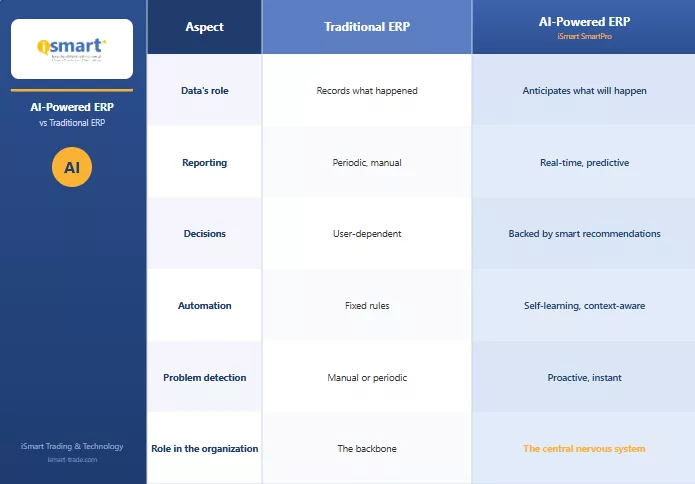
The real difference between traditional ERP and AI-powered ERP isn't a longer feature list — it's the question each one answers.
Traditional ERP answers: "What happened?" AI-powered ERP answers: "What's about to happen, and what should I do about it right now?"
Companies building on that difference today are setting themselves up with a competitive edge that will be hard to catch up to tomorrow.
Try SmartPro ERP directly. Explore the Demo or talk to our team for a needs assessment tailored to you: Contact Our Team
Read Also:
"The businesses that will lead Qatar's next growth phase are the ones digitizing today, not the ones waiting for certainty. SmartPro ERP gives them that head start."
All rights for iSmart company

{{page.totalItems}} Comments