


ERP System in Qatar | Business Guide
When the System Becomes a Burden Instead of a Tool
In Qatar, three systems hold more than 93% of the ERP market: Microsoft Dynamics 365 at 76.9%, followed by SAP at 15.4%, then Odoo at 11.5% — these are 2026 figures, according to wmtips data.
But market share doesn't answer the question that matters most: do these systems actually fit your company?
Large enterprises with substantial budgets and dedicated technical teams find a natural home in SAP and Microsoft Dynamics. Mid-sized companies — the backbone of Qatar's non-oil economy — face a different equation: systems designed for giant organizations, with a cost and complexity out of step with their size and the speed they move at.
This guide answers one question: how do you choose an ERP system that fits your company in Qatar in 2026 — not the most famous system, but the right one?
1. The ERP Market in Qatar — The Full Picture
Size and Growth
Qatar's cloud ERP market exceeded $1.2 billion by 2025 estimates. The global ERP market is on track to grow from $60 billion in 2024 to $119 billion by 2030 (BusinessWire). The Gulf contributes a growing share of that growth, driven by accelerating digitization initiatives.
In the Qatari context specifically, three factors shape demand for ERP:
- Qatar National Vision 2030: economic diversification means construction, logistics, hospitality, and healthcare are growing at a pace that calls for more sophisticated management systems.
- Binding government requirements: in 2023, the Qatari government issued regulations requiring government organizations to adopt cloud ERP by 2025 — with the impact expected to extend gradually into the private sector.
- Income tax and financial reporting: local financial and tax reporting requirements put companies still managing their accounts manually, or through scattered tools, in an increasingly difficult position.
Why Mid-Sized Companies in Qatar Need ERP More Than Anyone
Mid-sized companies are the fastest-growing segment in ERP adoption across the Gulf — Frost & Sullivan data indicates that 45–50% of ERP implementations in the region now come from the small and mid-sized business segment.
The reason is simple: a mid-sized company has grown large enough to generate operational chaos from scattered systems, but hasn't yet reached the size that would justify an investment in SAP or Oracle.
That's exactly the gap flexible ERP systems like Odoo and SmartPro ERP fill.

““The right ERP system doesn't just organize your business operations; it empowers your team to make smarter decisions, improve efficiency, and build a foundation for sustainable growth.” — iSmart”
2. What Is an ERP System? — The Definition That Matters to a Manager, Not a Programmer
If you want a deeper, ground-up understanding of ERP, see our article: What Is ERP?
For the manager making a decision today, the practical definition is this: an ERP system is the platform that gets your company's departments talking to each other instead of operating as isolated islands.
When the sales team issues an invoice → it reflects in inventory → it's recorded in accounting → and it shows up in the financial report. All of it is automatic, with no duplicate manual entry and no waiting.
That's what an ERP system actually changes.
3. The Systems Available in the Qatari Market — An Objective Comparison
The Three Most Present Systems
Microsoft Dynamics 365 — 76.9% market share. The most widely deployed system in Qatar. It integrates naturally with the full Microsoft environment (Office 365, Teams, Azure). Suited to large and mid-sized organizations already working within the Microsoft ecosystem. Cost: $65+ per user per month, with high implementation costs.
SAP — 15.4% market share. The global giant, designed for large enterprises. Strong in manufacturing and complex supply chains. Requires specialized technical teams and large budgets for implementation and maintenance. The best fit for large companies with highly complex operations.
Odoo — 11.5% market share (the fastest-growing). An open-source, modular system aimed at mid-sized companies. More than 16 million users across 100+ countries. Starts at $24.90 per user per month. Average implementation time: weeks, not months. Full details in our article: Odoo ERP — Features, Benefits, and Local Implementation.
The Fourth Option: AI-Powered ERP
A new category is taking shape fast — ERP systems that build AI into the core of their functions rather than bolting it on as a side feature. Predictive analytics, automatic anomaly detection, and real-time decision recommendations — this is what SmartPro ERP, developed by iSmart for the Gulf market, delivers. To see how this kind of system works: When Your Company's Data Stops Recording the Past and Starts Shaping the Future
4. The Specific Challenges of ERP Implementation in the Gulf Market
Specialized data and research from the Middle East point to recurring challenges that differ from those documented in Western markets:
1. Bilingual support as a structural requirement, not an option. Arabic support has to be native to the system—user interface, reports, documents, and user interaction—not a translation added later. A system that localizes its interface into Arabic while producing reports in English creates a usability gap inside the team.
2. Fit with local tax and regulatory requirements. Qatar's income tax requirements, labor and payroll regulations, and the report formats required by government bodies all need to be built into the system from the start. Customizing later to meet these requirements doubles the cost and stretches the rollout.
3. Human resistance to change—the leading cause of failure. Specialized research on ERP implementation across the Middle East (Springer, Cybrosys) indicates that user resistance to adopting the new system is the number-one cause of failure—even when the system is technically excellent. Change management and real training aren't an "add-on"—they're a condition of success.
4. Reliance on a specialized local partner. In the Gulf specifically, research has shown that the implementation partner is the strongest predictor of project success. MENA companies using ERP dashboards achieved 35% faster management reporting and a 28% drop in stockouts—but those results came from implementations guided by a partner with local experience (Alaan, 2025).
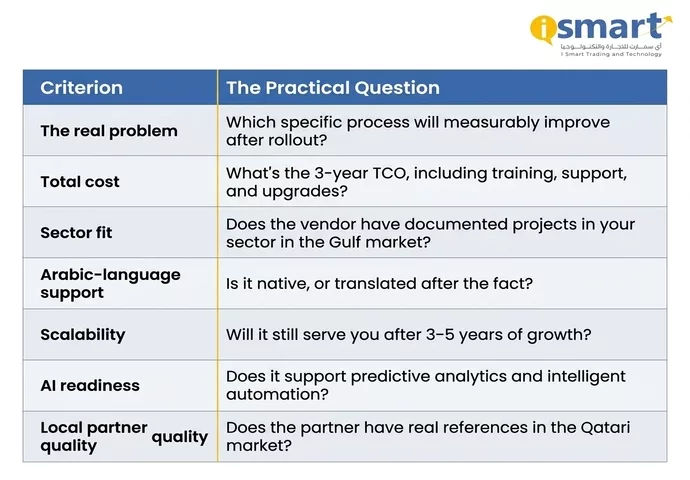
5. Seven Criteria for Choosing the Right System for Your Company
If you're at the comparison and evaluation stage, we have a detailed guide that covers these criteria in full: How Do You Choose the Right ERP System for Your Company?
A condensed framework to guide the decision:
6. What Any ERP Contract in Qatar Should Include
A point most companies overlook, even after choosing the system:
Data and code ownership: who owns your data when the relationship with the vendor ends?
Post-delivery support: what response time is guaranteed for critical issues?
Future updates: do system updates include future regulatory changes?
Training: is it a single session or an ongoing program?
Staged deliverables: are there clear milestones tied to payments?
Conclusion — The Right System at the Right Time
Qatar's ERP market is maturing fast. The question that was being asked five years ago ("Do we need ERP?") has become today's ("Which system fits us, and how do we implement it successfully?").
The answer always starts with a precise diagnosis of your requirements — not with comparing feature lists.
iSmart Trading & Technology has operated in the Qatari market for seven years, as a certified Odoo partner and as the developer of SmartPro ERP. We begin every project by analyzing your operations before proposing a solution.
Talk to our team for a free assessment that starts with understanding your business — not with a system pitch.
Read Also:
Related Tags
Social Share
{{ replyingTo ? replyingToText + ' ' + replyingTo.name : leaveCommentText }}
Search News
Popular category
Follow Us

Media Center
Subscribe for industry insights
All rights for iSmart company
{{page.totalItems}} Comments